

Best farmers take good crops not only in summer — but also in rainy and winter seasons. Monsoon brings rapid, unpredictable changes to pond water chemistry that can devastate a crop within hours. The farmers who come through it successfully are the ones who act before the problem appears — not after.
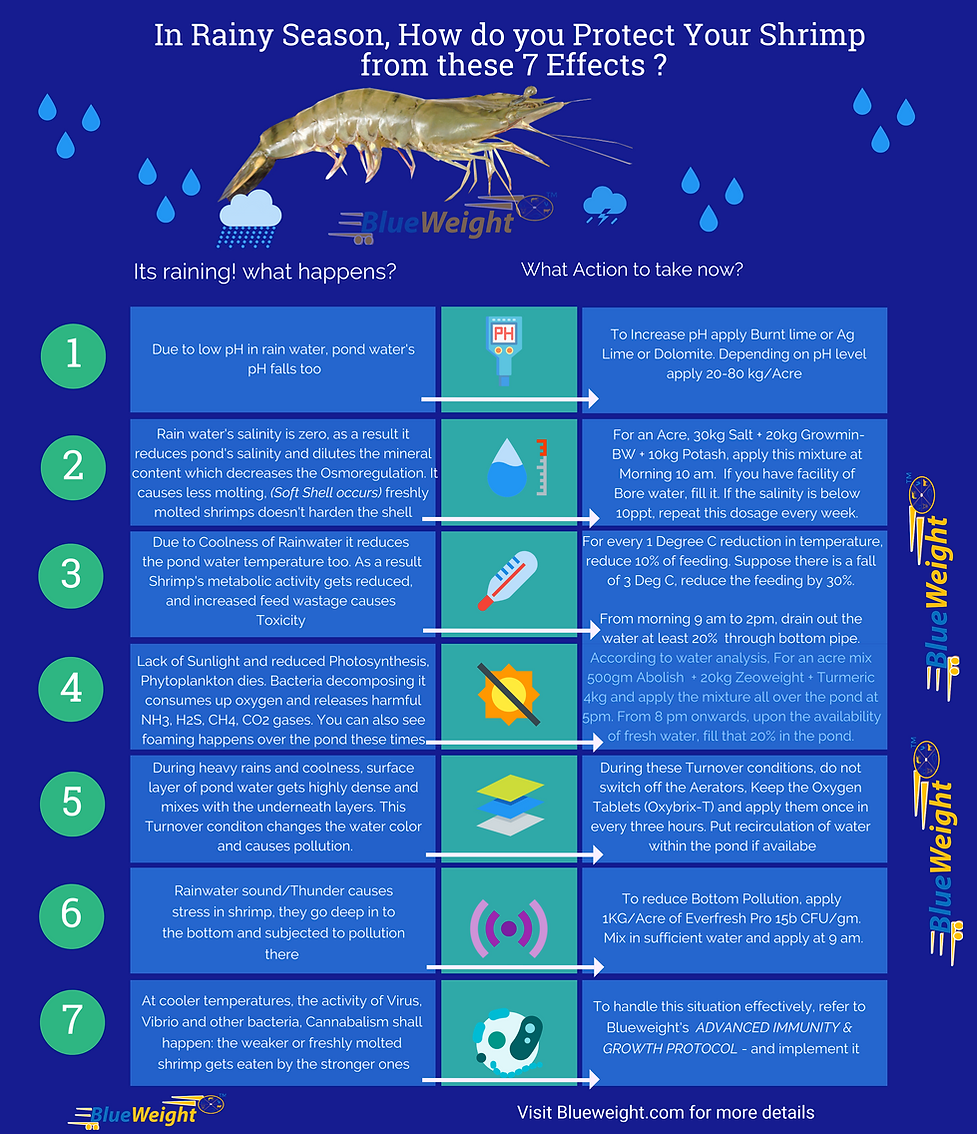
Here are the 7 most critical checkpoints to manage when heavy rain arrives at your farm.
Monitor Salinity — Immediately
Heavy rain rapidly dilutes pond salinity. Vannamei shrimp can tolerate 0.5–40 ppt, but a sudden drop of more than 5 ppt in hours causes osmotic stress. Test every 4 hours during prolonged rainfall. Below 5 ppt — reduce feeding immediately and consider partial exchange from a higher-salinity source.
Check pH — Act Fast if It Drops
Rainwater is naturally acidic (pH 5.5–6.5). Heavy rainfall can crash pond pH from 7.8–8.3 to dangerous levels within hours — especially in low-alkalinity ponds. Apply agricultural lime (CaO) at 10–15 kg/acre per 0.5 pH unit drop. Do not apply organic fertilisers during rain events.
Run All Aerators at Maximum
Cloud cover during rain eliminates photosynthesis — removing the pond's primary oxygen source. Simultaneously, bacterial decomposition of disturbed organic matter spikes oxygen demand. Run every aerator at full capacity during rain and for 6+ hours after. DO must not fall below 4 ppm at any point.
Reduce or Stop Feeding
During and immediately after heavy rain, shrimp experience stress and reduce feed intake. Uneaten feed settles and decomposes — spiking ammonia and H₂S. Reduce feeding by 50% during rain events. Resume full feeding only after water parameters stabilise for 12+ hours. Always use feed trays to monitor actual intake.
Apply Probiotics Post-Rain to Restore Microbial Balance
Rainfall dilutes and disrupts beneficial microbial communities. This creates an opening for Vibrio spp. and other pathogens to colonise the disturbed pond bottom. Apply a broad-spectrum Bacillus probiotic (Abolish or Ecofresh Power Pro) within 24 hours of a significant rain event to re-establish the beneficial bacteria population before pathogens take hold.
Block Runoff Channels — Prevent Contamination
Surface runoff from agricultural land introduces pesticides, herbicides, fertiliser residues, and pathogens directly into your pond. Before monsoon, inspect and reinforce all bund walls. During heavy rain, monitor inflow points and block runoff channels. Even a small volume of pesticide-contaminated runoff can cause significant mortality.
Watch for Plankton Crash — Respond Within Hours
Extended cloud cover during multi-day monsoon events can cause a complete phytoplankton crash — the water suddenly becomes clear or brown. This is an emergency. It removes both oxygen production and the food source for juvenile shrimp simultaneously. Increase aeration immediately and apply green water restoration products. A plankton crash followed by an overnight DO drop is one of the most common causes of total crop loss during monsoon.
Quick Reference — Rain Event Checklist
- ✦Test salinity, pH, and DO before rain ends
- ✦Run all aerators at maximum — no exceptions
- ✦Cut feeding by 50% immediately
- ✦Apply lime if pH < 7.5
- ✦Block runoff entry points
- ✦Apply Abolish / Ecofresh within 24h post-rain
- ✦Monitor plankton colour — act if water clears suddenly
Monsoon season rewards the prepared farmer. The difference between a successful crop and a loss often comes down to the first 6 hours of response. Know your parameters, keep your inputs ready, and act before stress becomes mortality.